


Review copy, 18 Oct 2026: DIY Home Staging: 10 Steps Before You Sell Your House, the way it will look as a guide page. Not linked anywhere, and nothing goes live until you say go. The Download the PDF buttons work once the PDF is uploaded. Photos come in the pictures step, after the guide is live.
Printable PDF. Yours to keep. No sign-up.
Download the PDFIn Instagram or Facebook? Tap the three dots, choose Open in browser, then download.
Why shampooing your own carpets can make them dirtier
Do-it-yourself carpet shampoo leaves a residue that attracts dirt, so you end up shampooing more and more, and the carpet and the pad get dirtier. Danny's advice: hire a pro.
The short answer
- Find, then fix. Start with what a Texas inspector has to write up, even in a house that met the code when it was built, and decide what's worth fixing.
- Clear and clean. Decluttering (91%) and cleaning the whole house (88%) were the two things agents most often recommended to sellers in NAR's 2025 survey.
- Then stage for the photos. In an eye-tracking study, home shoppers looked at a listing's photo first.
Jump to the checklists: before you list, and before every showing
Who this guide fits
- It fits you if you own an Austin-area house you're getting ready to list, whether you still live in it or it's empty. Most steps assume you live there, because so many of the searches do: "while living in it", "with kids", "with pets".
- Selling as is? The disclosure rules in step 1 apply either way, and steps 2 to 10 still help the photos.
- Rent it out, or buy, fix and sell for a living? EPA's lead-safe rule for older houses treats you differently from an owner who lives there (step 3).
- Not written for builders. This guide is for houses people have lived in. A brand-new home nobody has lived in isn't covered by the state's seller disclosure rule.
Do it yourself, or hire a stager?
Start by doing it yourself. The three things agents most often recommended to sellers in the National Association of REALTORS' staging survey are jobs you can do without a stager: decluttering, cleaning the whole house and improving curb appeal.
What the staging survey says, and what it doesn't. Many of the staging numbers you'll see come from that survey, NAR's Profile of Home Staging. Its 2025 edition asked agents, not buyers or sellers: 1,266 agents answered an online survey in February 2025, 2.5% of the 49,806 invited. Here's what they said:
- 83% of agents who work with buyers said staging made it easier for buyers to picture the home as their own.
- 26% said staging changed most buyers' view of a home, 60% said some buyers' view, and 12% said it made no difference.
- 29% of agents who list homes said staging raised the dollar value offered by 1% to 10%. And 17% of buyers' agents said staging brought offers 1% to 5% higher than on similar homes that weren't staged.
- 30% of listing agents said staged homes sold a little faster, and 19% said a lot faster.
- 21% of listing agents said they staged every listing, and 10% only the homes that were hard to sell. 51% said they didn't stage, but recommended that sellers declutter or fix faults.
Those are agents' impressions. Nobody sold the same house twice, staged and not, to measure the difference.
What independent studies found. The studies checked for this guide are about photos, not staging itself. A study of actual sales from one multiple listing service (the MLS, where agents list homes for sale) linked more listing photos with higher sale prices, with each extra photo adding less. More inside photos also went with a longer time on the market (Benefield, Cain and Johnson, 2011). In an eye-tracking lab study, people shopping for homes looked at a listing's photo first (Seiler, Madhavan and Liechty, 2012). So if staging pays off, the photos are where the evidence points.
What it costs. In the same survey, the median cost was $1,500 when a staging service was used, and $500 when the listing agent did the staging. The survey doesn't say what those prices covered. Doing it yourself costs mostly time and supplies, plus storage if you need it (step 2).
An illustration, not a promise. Take a $400,000 house. If staging changed nothing, you're out what you spent: your time and supplies, or about $1,500 for a staging service (the survey's median). If it lifted the offers by 1%, that's $4,000 more offered, or about $2,500 ahead after a $1,500 service. In the survey, 17% of buyers' agents put the lift at 1% to 5%, and 29% of listing agents at 1% to 10%. The survey doesn't say what the other agents said, and nobody can tell you in advance what your house would get.
Virtual staging. Software can add furniture to listing photos. Neither the REALTOR Code of Ethics nor Texas license rules ban it, but both bar listings that mislead: the Code bars "misleading images", and Texas rules bar ads that are "likely to deceive". The local MLS has its own photo rules, so if you use it, ask the listing agent how virtually staged photos have to be labeled, and don't let any edit hide a defect.
1Walk the house the way a buyer's inspector will
Start where the buyer's inspector will. A licensed Texas inspector follows the Texas Real Estate Commission's standards and fills out its report form. Deficient is the report's word for something that doesn't work the way it should, or is a safety hazard. Some conditions must be marked Deficient even if they were allowed when the house was built. TREC's own notice on the form gives examples:
- missing or faulty ground-fault (GFCI) and arc-fault (AFCI) protection;
- smoke alarms that are missing or don't work, and carbon monoxide alarms that don't work;
- ordinary glass where safety glass is expected;
- gaps between stair or rail posts that are too wide;
- appliances that weren't installed properly;
- missing electrical grounding, or missing bonding on gas lines;
- a bedroom without a working escape opening, such as a window that opens.
So a house that has been fine for 30 years can still collect a page of Deficient marks.
The small things the inspector's rules name. The same standards list conditions a seller can check before listing, for example:
- a smoke alarm in each bedroom, outside the sleeping area and on every floor, and a carbon monoxide alarm outside the bedrooms if the house has gas or other fuel-burning appliances, or an attached garage that opens into the house;
- missing or broken covers on outlets, switches and the electrical panel;
- the water heater's relief valve and its drain line;
- a range without its anti-tip bracket;
- garage door sensors mounted more than six inches above the floor, or a door that doesn't reverse;
- a dryer duct that isn't smooth metal, or doesn't vent outside;
- water standing in the air conditioner's backup drain pan;
- gutters, downspouts and soil that don't carry water away from the foundation.
The inspector tests smoke and carbon monoxide alarms and reports GFCI outlets that don't work, so press the test buttons yourself first.
Deficient isn't a repair order. TREC's notice says Deficient items don't oblige anyone to make repairs. What gets fixed is negotiated between buyer and seller. During the buyer's option period, the buyer can end the contract for any reason, which is why the inspection report carries weight then.
Fixing doesn't erase the history. Most Texas home sellers must give the buyer a Seller's Disclosure Notice (TREC's current form is 55-1). Besides items that need repair now, it asks about previous structural or roof repairs, previous termite damage and treatment, drainage, soil movement and flooding. A problem you fixed still gets a yes on the "previous" questions.
Built before 1978? There's lead paperwork too. Before the buyer is bound, you give them EPA's lead pamphlet, disclose any lead paint or lead hazards you know about, and hand over any lead reports you have. The buyer gets 10 days to have the house tested, unless you agree in writing on a different time or the buyer gives up the test in writing. If lead turns up, TREC's lead addendum (form 56-0) lets the buyer end the contract within 14 days after it takes effect. You don't have to test or remove anything.
Permits depend on your city. Round Rock, for example, lets homeowners do their own work on their primary residence. It requires a permit to replace an electrical, gas, mechanical or plumbing system, but not to re-roof or put up a fence. Check your own city before you replace a water heater, an AC unit, an electrical panel, a roof or a deck.
Fixing before you list isn't the same as fixing under contract. Unless you and the buyer agree otherwise in writing, a repair you agree to in the contract has rules. It must be done before closing, with any required permits, by people licensed for that work (or in that trade where no license exists), and you give the buyer the paperwork showing the work and the payment. So an agreed repair usually isn't a do-it-yourself job. Repairs you make before listing don't fall under that paragraph, but your city's permit rules still apply, and the disclosure form asks about work done without permits.
A pre-listing inspection is your call. No Texas rule requires one. If you order one, you're the inspector's client, and the inspector can't share the report without your OK. But what it finds becomes something you know, and the disclosure form asks what you're aware of.
2Declutter: pack what you won't need for 60 days
Pack anything you won't need for the next 60 days. Decluttering was the thing agents most often recommended to sellers in NAR's 2025 survey (91%). Start with a question: which three areas would be easiest to box up this week? Closets and cabinets count, since they're part of every showing. Put away family photos, kids' art, collections and anything with your name on it, so a buyer can picture their own things in the room. That's all "depersonalize" means.
Living there while it's listed? Keep one basket per room for the daily things that come out, and put the basket away before each showing.
Where it goes in Austin. City of Austin curbside customers book bulk-item pickups by appointment, up to three a year, through the Austin Recycles app, online, or by calling 3-1-1. Items go to the curb by 5:30 a.m. on the appointment day, and not in bags or boxes. Book it before photo day, so the pile isn't in the pictures. The Recycle and Reuse Drop-off Center (2514 Business Center Dr., by appointment, no charge for Austin and Travis County residents) takes paint and household chemicals, and its ReUse Store passes usable things on. The City's Austin Reuse Directory lists places to donate. Suburbs differ: Round Rock gives in-city residents one bulk pickup a year, booked with Republic Services a week ahead, and Pflugerville takes up to six items on your regular pickup day.
If you need storage. A 10x10 unit in Austin listed at about $92 a month on average (SpareFoot, September 2026; actual rates vary by place and with move-in deals). A storage pod parked in an Austin street needs a City permit, requested at least three business days ahead. Approval is case by case, and the dates can't be stretched. If you're in a homeowners association, check its rules on pods too.
3Paint: touch up, and work lead-safe in older houses
Touch up first; repaint where it shows. Fill nail holes, touch up scuffs, and repaint the walls that won't touch up cleanly. Do it before the deep clean (step 4), so you only clean once.
If the house was built before 1978, work lead-safe. Older paint may contain lead, and sanding or scraping it makes dust. EPA's renovation rule covers paid work: a painter or handyman disturbing more than 6 square feet of painted surface in a room, or 20 square feet outside, must be EPA-certified and follow its lead-safe practices. Replacing a window counts, whatever its size. EPA says the rule generally doesn't apply to owners working on their own home, unless you rent it out, run a child care there, or buy, renovate and sell homes for profit. Its advice for doing it yourself is to contain the work area, use lead-safe methods, and clean up with wet disposable cloths. The methods it bars for paid work are the ones to avoid: open-flame burning, power sanding or grinding without a shroud hooked to a HEPA vacuum (one with a very fine dust filter), and heat guns above 1,100°F. Selling a house built before 1978 also has its own paperwork (step 1).
Leftover paint has rules too. In Austin, liquid paint can't go in the trash, down the drain or on the ground. Take it to the Recycle and Reuse Drop-off Center by appointment, or book a household hazardous waste pickup at your home (up to 30 gallons a pickup). Set it where the crew can reach it, out of the rain and sun, but not at the curb. In Round Rock, let latex paint dry in the open can, then set the can, lid off, next to your trash cart on pickup day. Austin also gives away its recycled ReBlend paint, a flat paint in three colors, by appointment at the drop-off center.
Which brush and roller to paint with: a 3-inch angled sash brush, and a roller with a 3/4-inch nap or thicker. Spend the money on the tools: less work, higher quality.
4Clean the whole house, starting with what the inspector checks
Start with two jobs the inspector checks too.
- Under the sinks. Empty the cabinets, wipe them out, and look for drips. Active leaks are on the inspector's list.
- The air filter. Put in a clean one. Filters are on the inspector's list for the heating and cooling system.
Then clean the whole house, not just the rooms people see first. Cleaning the entire home came second among agents' recommendations to sellers in NAR's 2025 survey (88%), right after decluttering. Baseboards, fans, window tracks, and the inside of the oven and fridge all show.
Deep clean the baseboards, the fridge and the pantry. Dust attracts dust and dirt attracts dirt, so a deep clean once a year keeps the house cleaner throughout the year.
5Fix smells at the source
Find the source, then fix it. Take the trash out daily while the house is listed. Clean the fridge, the drains and the dishwasher filter. Wash pet beds, throws and curtains, clean the litter box daily, and move it out of the main rooms.
Go easy on scents. A candle or air freshener covers a smell; it doesn't remove it. Never leave a candle burning for a showing. A musty smell is a different job: find where the damp is coming from, because the disclosure form asks about water damage that didn't come from a flood.
6Make room to inspect, and room to move
Leave room for the inspector first. Under the inspector's standards, anything reachable only by moving furniture or large, heavy or fragile objects doesn't count as accessible. Keep these clear: the electrical panel, the attic hatch or pull-down stairs, the water heater, the air conditioner and its indoor unit, the space under the sinks, and the garage walls. What the inspector can't reach may not get inspected.
Then thin out the furniture, and clear the paths. Take out extra chairs and table leaves, and leave a clear path through each room and to the back door.
Empty house? Leave the utilities on. The contract requires the seller to turn on the existing utilities at the seller's expense and keep them on. An inspector can't test a water heater, an air conditioner or the outlets with the power and water off.
And call your insurance company. The Texas Department of Insurance says most homeowners policies don't cover losses once a house has sat empty for the number of days the policy sets, and most companies stop coverage when a house is vacant for 60 days or more. If you've moved out, ask your company how to keep the house covered.
7Light every room for the photos
Light is for the photos first. In an eye-tracking study, home shoppers looked at a listing's photo first (Seiler, Madhavan and Liechty, 2012).
Clean the windows, and look between the panes. A double-pane window that stays foggy between the glass has a broken seal, and the inspector's standards list it.
Then, before photo day: dead bulbs replaced, with one color of bulb in each room; blinds and curtains open; every light and lamp on.
8Show what each room is for, starting with the table
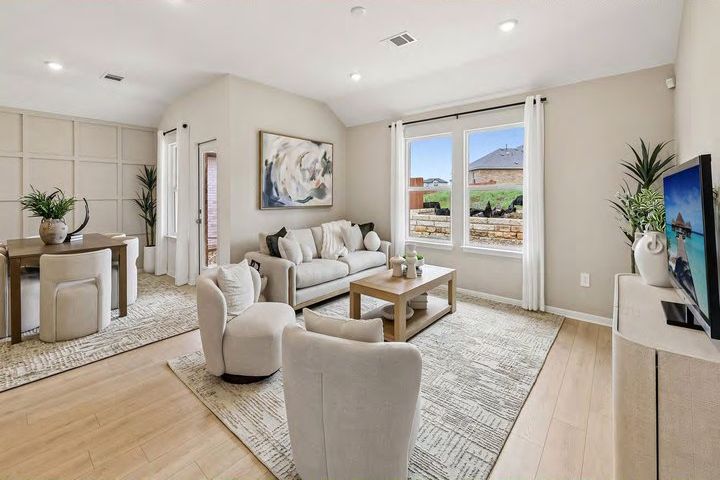
Show what each room is for. When listing agents in NAR's survey staged, they most often did the living room (91%), the primary bedroom (83%), the dining room (69%) and the kitchen (68%). For the table: a clean runner or cloth, a place set at each chair the table seats comfortably, and one low centerpiece. The kitchen table counts too. Clear the counters down to one or two things. A spare room reads better with one clear use, a guest room or an office, than as storage.
9Check the bedroom windows, then make the beds
Check two safety items first. Every bedroom window should open. The inspector's standards report a bedroom without a working escape opening as Deficient, and TREC's notice says that holds even in an older house. And each bedroom should have a smoke alarm (step 1).
Then start with the primary bedroom. Buyers' agents in NAR's survey rated it the second most important room to stage (34%), after the living room (37%). Plain, light-colored bedding, clear nightstands, and nothing showing under the bed.
10Tidy the front, and water by your city's rules
Start the yard early. In Austin, sprinkler systems get one day a week.
The front of the house is often the first photo, and it's the first thing anyone sees in person. Improving curb appeal came third among agents' recommendations to sellers in NAR's 2025 survey (77%). Mow, edge and weed, trim shrubs back from the house and the windows, and make sure the porch light works.
Water by your city's rules. Austin's watering rules move with its water supply. In its year-round Conservation Stage, the stage in place when this guide was checked, automatic sprinkler systems may run one day a week, set by your address, and hose-end sprinklers two days, from midnight to 10 a.m. or from 7 p.m. to midnight. Hand watering is allowed any day, at any time, so a hose or a watering can keeps pots and beds alive between sprinkler days. Breaking the rules can cost up to $1,000. Round Rock and Georgetown allow two days a week by address, with their own hours. Check your water provider's page before you set the timer.
Water the soil around the foundation, on your day. Austin Water says you may water your home's foundation on your assigned watering day and times, with sprinklers set to water the ground about 18 inches from the foundation. Parts of the Austin area sit on clay soil that shrinks when it dries and swells when it's wet. Drainage, grading and gutters are on the inspector's list too, and the disclosure form asks about soil movement.
Plants that live here. The City's Grow Green plant guide lists plants native or adapted to the Austin area, and you can sort them by how much water they need.
The checklists
Before you list
- Walk the house with the inspector's list. (Date done ________)
- Smoke and carbon monoxide alarms tested
- Outlet, switch and panel covers on
- GFCI outlets: test and reset buttons work
- Water heater: relief valve with a drain line
- Range: anti-tip bracket
- Garage door: sensors low, door reverses
- Dryer duct: smooth metal, vents outside
- AC backup drain pan: dry
- Gutters and soil carry water away
- Permits checked for anything you replace
- Built before 1978: lead pamphlet and disclosure ready
- Pack what you won't need for 60 days. Book pickups before photo day. (Pickup date ________)
- Touch up or repaint, before the deep clean. Built before 1978? Work lead-safe. Leftover paint to the drop-off center or a hazardous waste pickup.
- New air filter. Under the sinks: dry? Then clean the whole house.
- Find smells and fix them at the source.
- Panel, attic hatch, water heater and AC reachable. Furniture thinned, paths clear. Empty? Utilities on, insurance company called.
- Bulbs replaced, one color per room. Windows clean.
- Table set. Counters down to one or two things. Each room has one clear use.
- Every bedroom window opens; every bedroom has a smoke alarm. Beds made.
- Front yard and door done. Watered on your days, with sprinklers set to hit the ground about 18 inches from the foundation.
Before every showing
- Lights on, blinds open.
- Counters clear, dishes away, trash out.
- Beds made, towels fresh.
- Pets, bowls and litter box out of sight.
- Valuables, medicines and personal papers put away.
- The thermostat at a comfortable setting.
- Walk and porch swept, porch light on.
Where to next
See what your home is worth See what the Austin market is doingCall or text Danny at 512-825-7754, or send a message.
Keep it, or pass it on:
Who wrote this
Danny Baisley: 35+ years in the housing industry, 20+ years as a contractor, a former home inspector, and 25+ years licensed in Texas. Last updated October 2026.
What clients have said
"Okay we all know that selling a house can be very stressful. I'm not going to say the cliché thing that Danny made it not stressful because it's a HUGE transaction in one's life. Danny listened; he treated me with the utmost respect through the whole process, and put me at ease. Danny negotiated for me well. ALWAYS called me back quickly. I would recommend Danny for your real estate needs. He's a great guy, professional, fun, and made the sale of my house turn out very much in my favor!!"
Molly S., Austin, TX
"Danny helped me recover my investment in a home and then was a superb caring and knowledgeable resource for me to get relocated in my preferred price point. He was steadfast with me during these two processes, and I have ended up just where I needed to be! His communication and follow-through was excellent. You will not regret having him working with you."
Joan Ross